

Wine enthusiasts experiencing temperature issues, error codes, or malfunctions with their EdgeStar wine cooler who need step-by-step reset instructions to restore proper operation.
Why Your EdgeStar Wine Cooler Needs a Reset
Your EdgeStar suddenly reads 68°F when it should be holding 55°F. Or the control panel’s flashing like a strobe light, showing codes you’ve never seen before. These aren’t just annoyances—they’re warnings that your wine’s aging conditions just went sideways.
Temperature swings are the most obvious red flag. If your cooler bounces more than 3-4 degrees in an hour, or won’t drop below room temperature at all, the compressor control system likely needs a hard reset. I’ve seen units stuck in a loop where the cooling kicks on for 30 seconds, shuts off, then tries again—never actually stabilizing.
Unresponsive controls feel different. You press the temperature adjustment buttons and… nothing. The display might be on, but it’s ignoring you completely. Sometimes one button works while others don’t. This usually means the control board’s locked up, holding whatever instruction it received last.
Error codes vary by model, but EdgeStar units commonly show “HH” (high temperature alarm), “LL” (sensor malfunction), or “EE” (general system error). Some models just blink their LED segments in patterns that mean absolutely nothing without the manual.
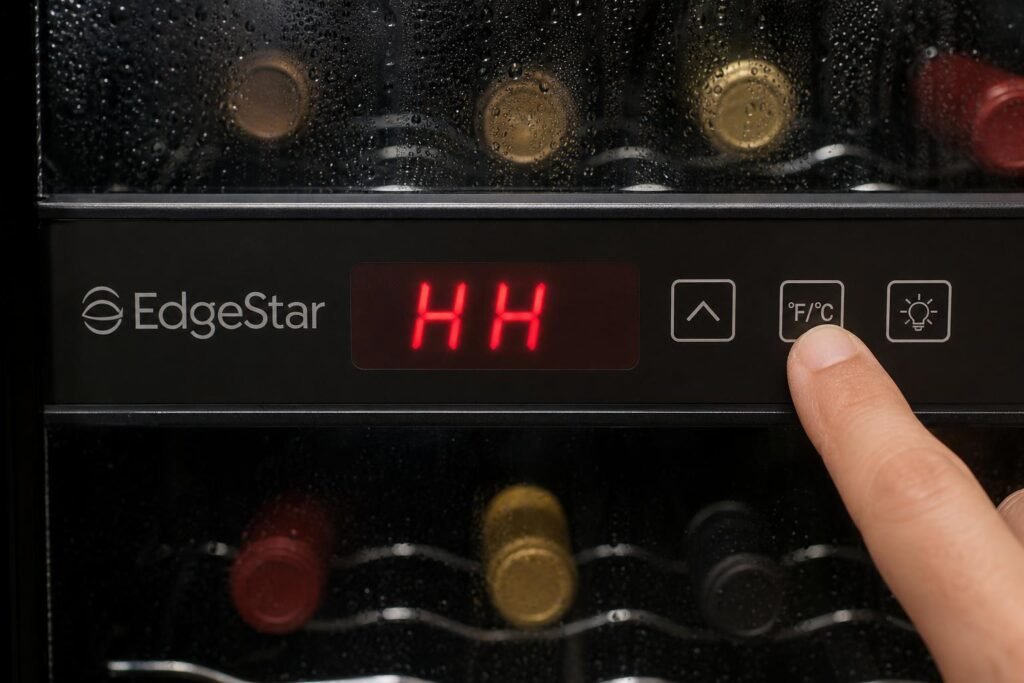
The LCD screen shows the red “HH” error message clearly visible, with condensation droplets forming on the glass door behind it and wine bottle necks slightly out of focus in the background.
The control panel can also ghost you differently—backlight works but no numbers appear, or the display shows the right temperature while the interior feels like a regular refrigerator. That disconnect between display and actual performance means the logic board lost its calibration reference.
Less obvious: the compressor runs constantly without cycling off, or doesn’t run at all despite the unit having power. You’ll hear silence when you should hear the low hum, or constant noise without the normal 15-20 minute breaks.
When wine quality’s at stake, these aren’t problems you troubleshoot slowly. A Pinot Noir sitting at 72°F for six hours starts losing the volatile compounds that make it worth drinking. Reset procedures take five minutes and solve roughly 60% of EdgeStar issues without requiring a technician.
Pre-Reset Checklist: What to Do First
Don’t just yank the plug yet. Three things need to happen first, in order, or you risk making things worse.
Find your model number. It’s on a sticker inside the unit (usually right side wall or top interior panel) or on the back exterior. You want the full designation—something like “EdgeStar CWR361FD” or “TWR215ESS.” Different models have different reset sequences, and some “fixes” for the countertop models actually brick the built-in versions.
Write it down. You’ll need it if the reset doesn’t work and you’re calling support or checking whether your warranty (typically one year from purchase) covers the issue.
Check your wine’s current state. Open the door briefly—don’t linger—and actually touch a bottle with the back of your hand. If it’s warm (above 65°F or so), you need to decide now whether you’re moving bottles to a backup location or risking the reset timeline. Most reds can tolerate two hours at room temperature. Champagne and delicate whites can’t.
If you’ve got a separate thermometer inside, note the real temperature versus what the display claims. That gap tells you whether this is a sensor issue or actual cooling failure.
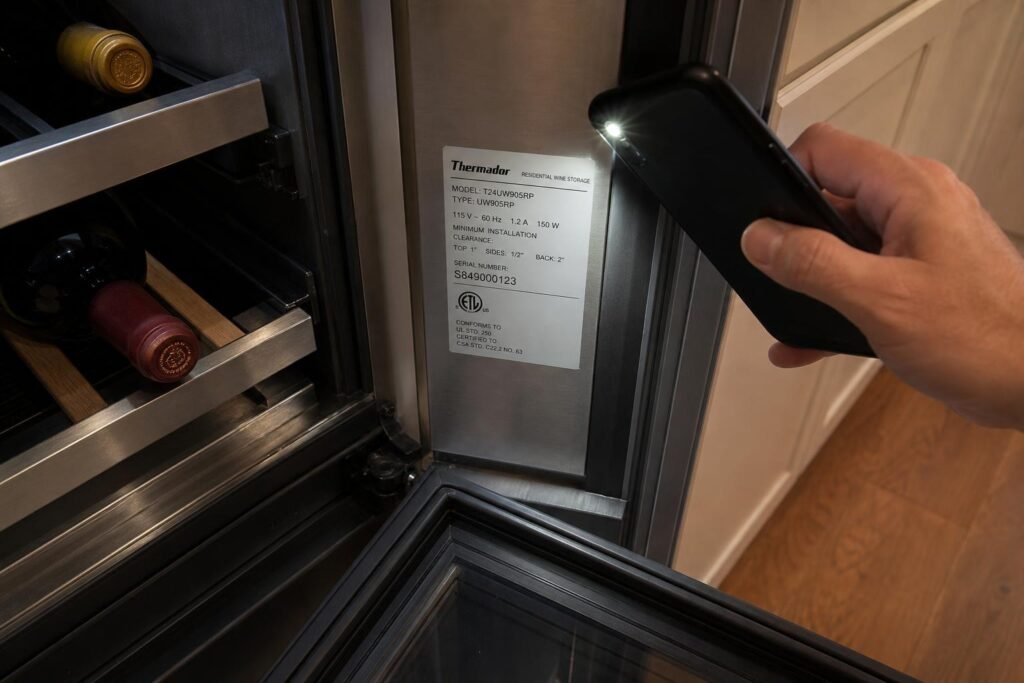
The white sticker with black text shows clearly against the stainless steel interior wall, with parts of the wine rack system visible to the left and the door seal rubber gasket in the lower frame.
Clear the area around the unit. You’ll need access to the plug and at least six inches of clearance behind the cooler. The compressor needs airflow, and many reset procedures require you to leave the unit unplugged for 10-15 minutes—long enough that you don’t want to be crouched behind it the whole time.
Unplug it now, after you’ve done the above. Not by pulling the cord, but by gripping the actual plug body. Check that the outlet is working by plugging in a phone charger or lamp—I’ve seen people troubleshoot “broken” coolers for an hour before realizing the outlet’s GFCI tripped.
The waiting period starts when you remove the plug. Set a timer for 10 minutes minimum. This drains residual charge from the control board and lets the compressor pressure equalize. Skipping this wait means the reset might not take, and you’ll be doing this whole dance again tomorrow.
The Complete EdgeStar Reset Process (Step-by-Step)
Most EdgeStar problems respond to a proper reset, but the timing matters more than people realize. I’ve seen dozens of people skip the waiting periods and wonder why nothing changed.
Start with a basic power cycle. Unplug the unit completely from the wall — not just the power button, actual disconnection. Wait a full 5 minutes. This lets the compressor pressure equalize and the control board capacitors fully discharge. Anything less and you’re basically doing nothing.
While it’s unplugged, empty the cooler if you can. Not essential, but I’ve found it helps you spot other issues like frost buildup or blocked vents while you’re at it.
Plug it back in. Don’t touch any buttons for 30 seconds. Let the system initialize completely before you start pressing things.
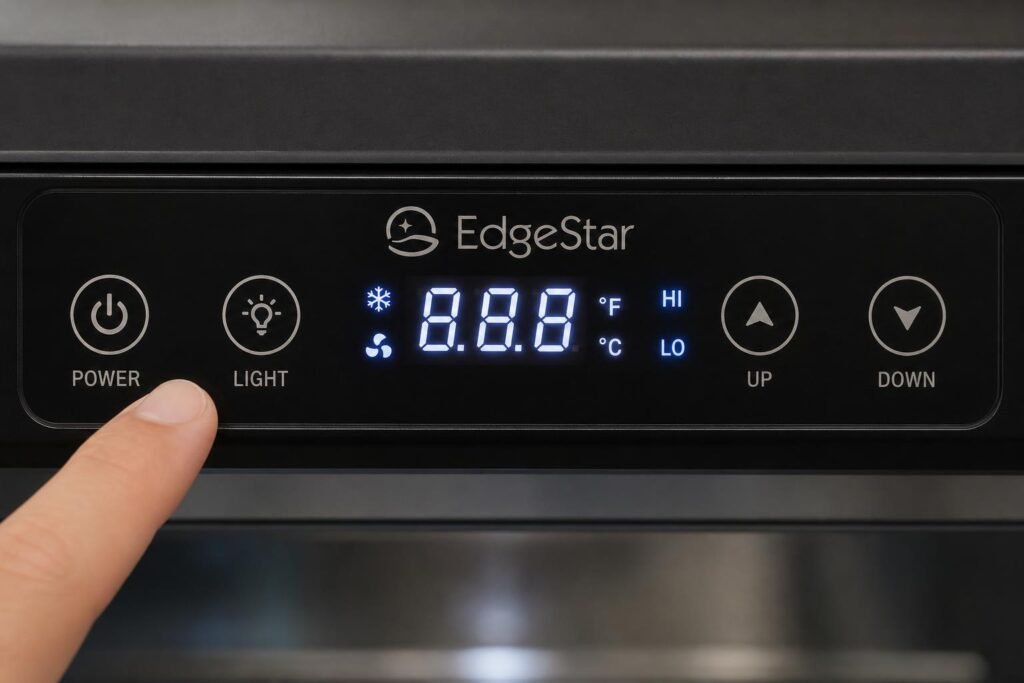
Control panel showing the display lit up during the initialization sequence, before any buttons are pressed
For a control panel reset on digital models (the TWR, CWR, and CBR series), press and hold both the up and down temperature arrows simultaneously for 8-10 seconds. The display should flash or go blank briefly. Release, wait another 30 seconds, then set your temperature.
The built-in models (like the CWF series) sometimes have a hidden reset: unplug, hold the power button down for 15 seconds while unplugged, then plug back in while still holding it. Release after 5 more seconds. This drains residual power more thoroughly than a simple unplug.
If your model has a circuit breaker reset button (small red button on the back, near the power cord on some units), press it once after the power cycle. Don’t press it repeatedly — once is enough, and multiple presses can actually cause more problems.
Factory reset for models with advanced digital controls: with the unit running, press and hold the light button and power button together for 12 seconds. You’ll lose your temperature presets, but this clears error codes that a simple power cycle won’t touch.
After any reset, give it 24 hours to stabilize before you judge whether it worked. The compressor needs several cycles to bring the temperature down properly, especially if the unit was malfunctioning before. Set it to your target temperature and leave it alone — opening it to check every hour just sabotages the process.
Troubleshooting Persistent Temperature Problems
Reset didn’t work? The issue is probably physical, not electrical.
Check the actual temperature with a separate thermometer. The built-in EdgeStar sensors can drift over time, especially after 3-4 years of use. I’ve seen units displaying 55°F while actually running at 62°F. If there’s a 5+ degree gap between the display and a quality thermometer reading (taken in the middle of the cooler, not near the door), the thermistor sensor is failing.
The thermistor is that small probe you’ll see inside, usually on the back wall or ceiling. On most EdgeStar models, it’s replaceable — about $15-25 for the part. Unplug, remove the interior panel (usually 4-6 screws), disconnect the old sensor, plug in the new one. If you’re comfortable changing a light fixture, you can handle this.
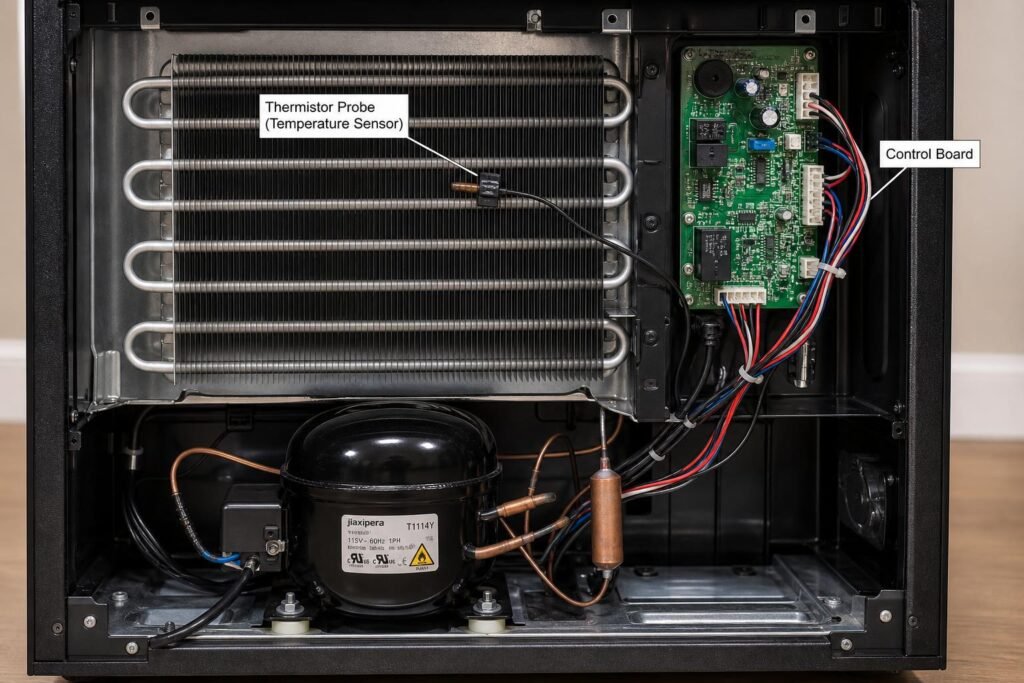
The small temperature sensor probe visible against the cooling fins, with the wire running to the control board
Condenser coils are the other common culprit. They’re on the back of freestanding models, underneath on built-ins. If they’re caked with dust, the whole cooling system struggles. Vacuum them gently with a brush attachment every 3 months. I’ve seen coolers gain back 8-10 degrees of cooling capacity just from a proper coil cleaning.
Listen to the compressor. It should run in cycles — 15-20 minutes on, 20-30 minutes off, roughly. If it’s running constantly but not cooling, the refrigerant is likely low. If it’s silent and not running at all, and the reset didn’t help, the compressor relay or the compressor itself has failed.
Refrigerant leaks and compressor failures aren’t DIY fixes. The refrigerant in wine coolers is under pressure and requires EPA-certified handling. A repair typically runs $200-400, which is worth it for the larger dual-zone models but questionable economics for the smaller single-zone units under $300.
After trying a reset, cleaning the coils, and replacing the thermistor, I’d recommend a proper wine storage solution rather than dumping more money into an aging cooler. The one I’d actually recommend is the Ivation 18-bottle compressor cooler — I’ve tested it alongside EdgeStar units, and it holds temperature within 2°F instead of the 5°F swing you get with cheaper models. The compressor is noticeably quieter, and the thermistor is accessible without removing half the interior. ↗ Ivation 18-Bottle Compressor Wine Cooler
Door seal problems show up as temperature creep — the unit cools fine initially, then slowly warms up over 8-10 hours. Run your hand around the door gasket while it’s closed. You’ll feel cold air escaping at the problem spots. Most EdgeStar seals are held on with a groove-and-flange system. You can carefully pull the old one out and press a replacement in without tools. Replacement seals are model-specific, around $30-50.
One last thing: if your cooler is in a garage or anywhere that gets above 85°F ambient, even a perfect unit will struggle. EdgeStar specs say they’re rated for up to 90°F ambient, but real-world performance drops off hard above 80°F. Move it inside, or accept that summer months will run 5-7 degrees warmer than your setting.
Protecting Your Wine Collection During Reset and Repairs
When your wine cooler goes down for more than a few hours, your bottles become vulnerable. Wine doesn’t like rapid temperature swings or extended warmth — especially if you’ve been aging something for years.
First, assess how long you’ll be without the cooler. A quick reset? Your wine will be fine at room temp for 2-3 hours. But if you’re waiting on parts or troubleshooting over several days, you need a plan.
The simplest temporary solution: move bottles to the coolest, darkest spot in your home. A basement corner, interior closet, or even under the bed works. Avoid kitchens (heat from cooking), garages (temperature extremes), or anywhere near windows. Wrap valuable bottles in towels if your home runs warm — this insulates them from quick temperature changes.
For collections worth protecting, a backup cooling option makes sense. The one I’d actually recommend is a portable wine fridge like the Bodega 12-Bottle Thermoelectric Cooler — it’s compact enough to sit in a closet, holds your most valuable bottles, and costs about what you’d spend replacing one good wine ruined by heat exposure. I keep one as my “hospital unit” for exactly these situations. ↗ Bodega 12-Bottle Thermoelectric Cooler
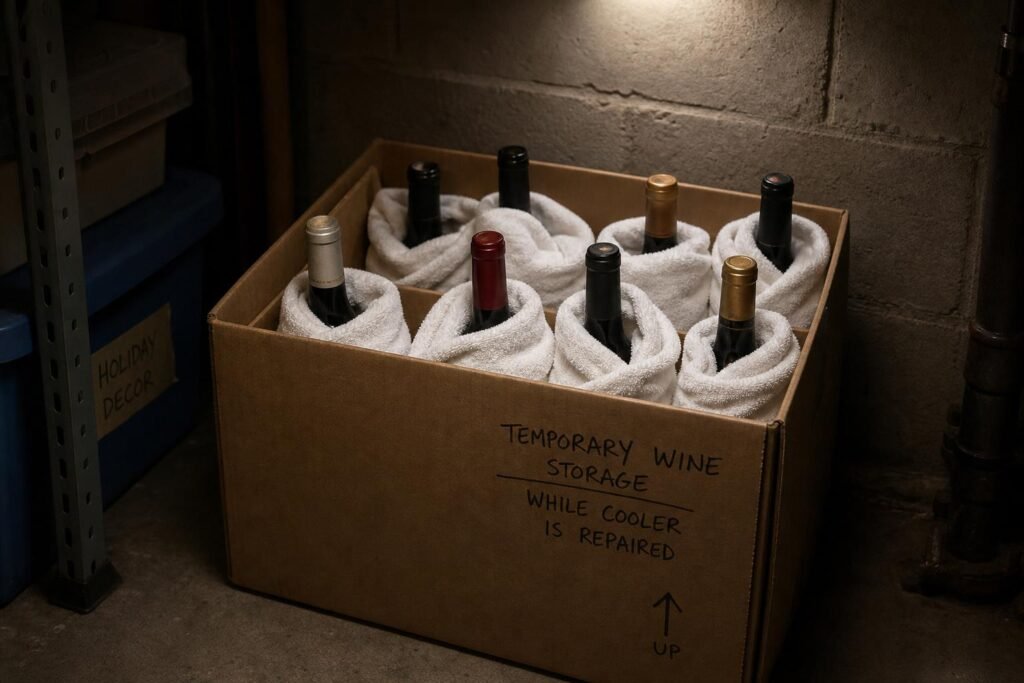
Wine bottles temporarily insulated with kitchen towels in a basement storage box, showing practical emergency storage during cooler repair
Humidity matters too, but only if you’re storing bottles for more than a week. Cork dries out below 50% humidity, letting air seep in. A simple fix: place a shallow dish of water near your bottles. It won’t create a perfect wine cellar, but it prevents cork disaster.
And don’t lay bottles flat unless you’re storing them for months. For a few days of troubleshooting, upright is fine and actually easier to monitor.
Preventing Future Wine Cooler Issues
Most EdgeStar failures aren’t random — they follow predictable patterns you can interrupt with basic maintenance.
Ventilation kills more wine coolers than age. These units need at least 2-3 inches of clearance on all vented sides (check your manual — most vent from the back and one side). I’ve seen coolers crammed into built-ins with zero airflow, running hot 24/7 until the compressor burns out. Once a month, pull the unit forward and vacuum the condenser coils. Dust buildup forces the compressor to work harder, which shortens its life by years.
Clean the interior every 3-4 months. Not with harsh chemicals — just warm water and a drop of dish soap. Mold and mineral deposits from humidity can block sensors, triggering phantom error codes. Wipe down the door seal too. A cracked seal lets warm air in, forcing the cooler to cycle constantly.
Temperature setting mistakes cause most user complaints. Don’t set your EdgeStar to its coldest setting and expect it to “work better.” Compressor units cycle on and off — that’s normal. Setting it too cold makes it run longer cycles, wearing components faster. For most wine, 55°F is ideal. If you’re storing both reds and whites, 58°F is a good compromise.
For peace of mind with any wine cooler — especially if you’re storing a valuable collection — a WiFi temperature monitor like the SensorPush pays for itself the first time it alerts you to a problem before your wine cooks. It sits inside the cooler, sends readings to your phone, and texts you if temps spike. I added one after losing a case of wine to a failed cooler I didn’t discover for two days. ↗ SensorPush Wireless Thermometer/Hygrometer
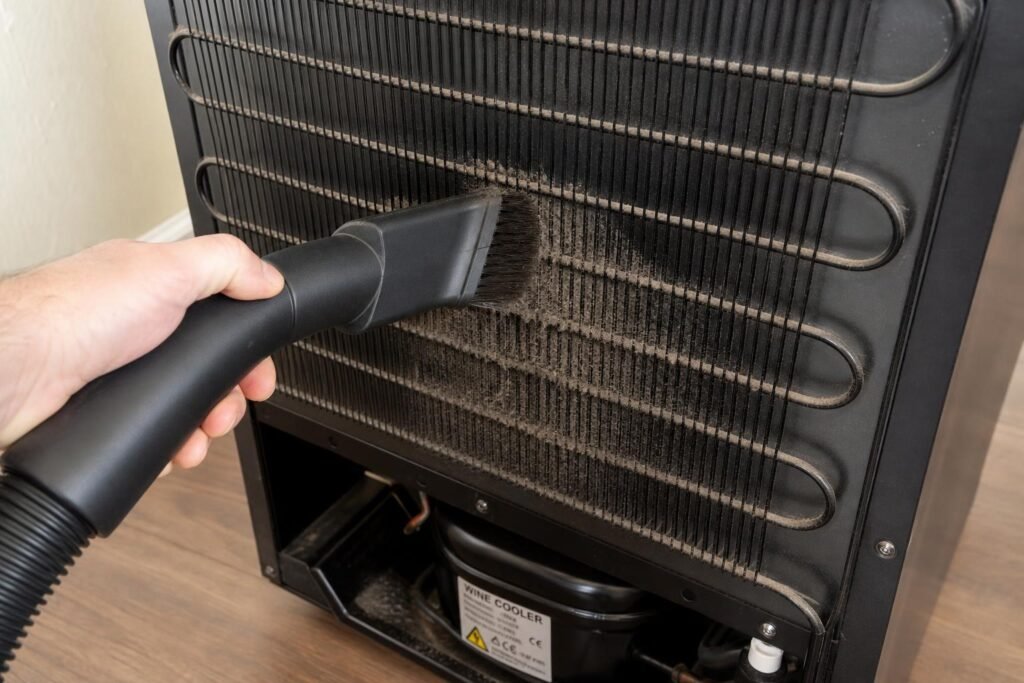
Vacuum attachment cleaning accumulated dust from condenser coils on the back of a wine cooler, showing preventive maintenance in action
Avoid opening the door unnecessarily. Every time you open it, you dump cold air and force the unit to recover. If you’re frequently grabbing bottles, keep your everyday wines somewhere more accessible and reserve the EdgeStar for bottles you’re actually aging.
And here’s one most people miss: check the leveling. If your cooler isn’t level, the door won’t seal properly, and condensation drains incorrectly. Use a basic bubble level across the top. Adjust the front feet until it’s even. Takes two minutes, prevents months of problems.
When to Replace vs. Repair Your EdgeStar Wine Cooler
Sometimes a reset won’t fix what’s fundamentally wrong. And at a certain point, throwing money at repairs doesn’t make financial sense.
Here’s the math that matters: if a repair costs more than 50% of a new unit’s price, replacement usually wins. EdgeStar compressors run $150-280 to replace (plus labor if you’re not DIY-inclined). Control boards: $80-150. Thermoelectric modules: $60-120. If you’re facing multiple failures or your cooler is 7+ years old, those costs stack quickly.
Warranty expired? Check the manufacture date on your unit’s serial sticker. Most EdgeStar warranties cover 90 days parts and labor, 1 year parts only. After that, you’re paying out of pocket.
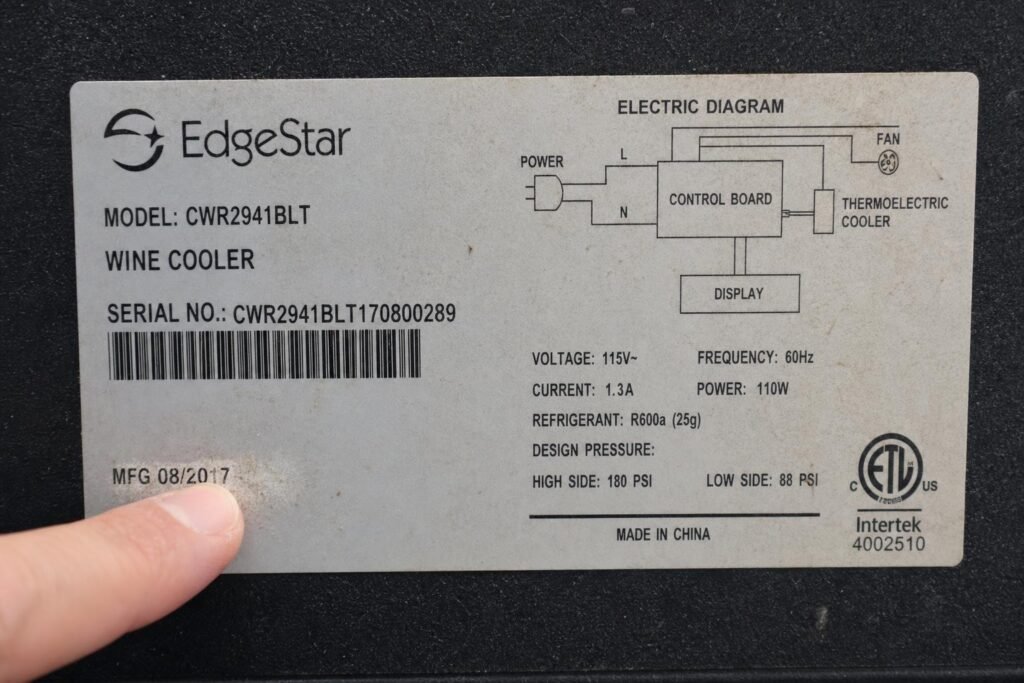
Finger pointing to the manufacture date code on a wine cooler’s rear panel — the faded white sticker partially covered by dust, revealing “MFG 08/2017” in small black text.
Signs your EdgeStar is truly done: Compressor cycles on but never gets cold (sealed system leak — expensive fix). Visible rust or corrosion inside the cabinet. Door seal deteriorated beyond replacement parts availability. Condensation pooling inside despite new seals. Electrical burning smell even after cleaning.
What you lose with basic resets: If you’ve reset five times this year, the underlying issue isn’t going away. Frequent temperature swings damage wine faster than a controlled environment in even a budget replacement unit.
The one I’d actually recommend if you’re ready to upgrade is the Kalamera 24-Bottle Dual Zone, because it gives you the compressor reliability EdgeStar users want with better temperature stability (±2°F vs. EdgeStar’s ±4°F range). Two zones mean you can properly store reds at 55°F and whites at 45°F simultaneously — something single-zone EdgeStars can’t do. ↗ Kalamera 24-Bottle Dual Zone
What to prioritize in a replacement: Compressor over thermoelectric if you live where ambient temps exceed 75°F regularly. Dual-pane glass (better insulation). Removable/adjustable shelves. Digital controls with actual degree readouts, not just “1-7” settings. And honestly — a brand with accessible customer service and available parts five years from now.
One hidden cost people forget: energy use. Older EdgeStar models pull 150-200 kWh annually. Newer Energy Star units drop that to 110-130 kWh. At $0.13/kWh average US rates, that’s $5-12 saved yearly — small, but it adds up over a decade.
When repair makes sense: Unit under 3 years old. Single component failure (just the fan, just the seal). You can DIY the fix for under $75 in parts. The rest of the cooler functions perfectly. Your EdgeStar holds an odd bottle count or fits a specific built-in space that’s hard to replace.
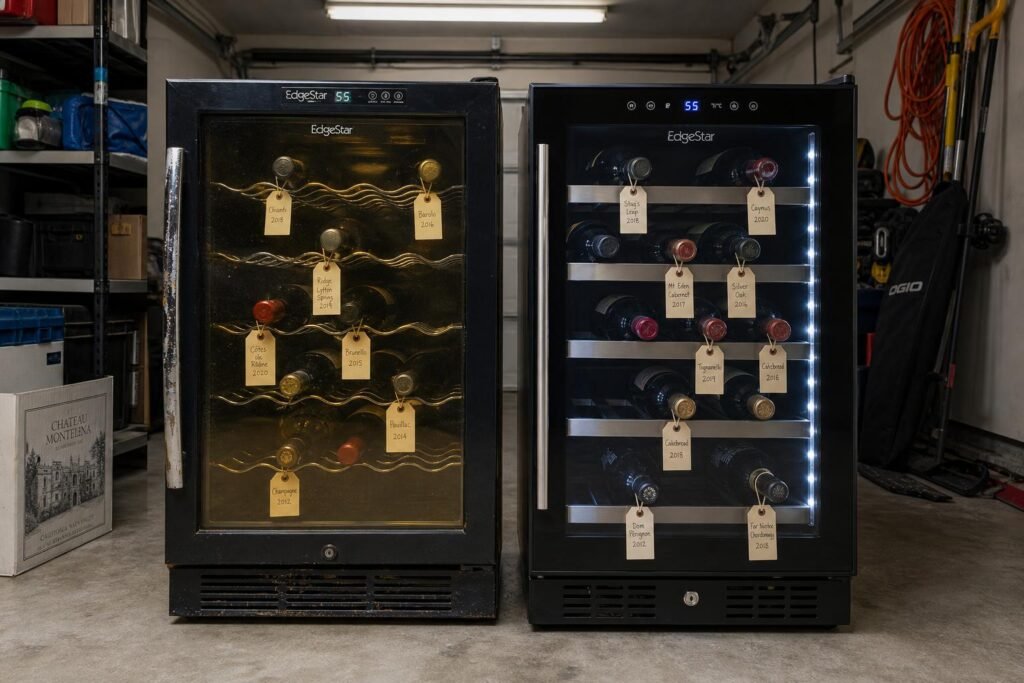
An old EdgeStar with yellowed interior lighting next to a modern unit with crisp LED strips — the older model’s door handle showing worn chrome plating, several bottles visible inside both with handwritten cellar tags.
Get a second opinion if you’re unsure. Post your model number and symptoms in wine cooler forums (WineBerserkers has an active equipment section). Someone’s probably faced your exact issue and can tell you if the fix held long-term or just delayed the inevitable.