

EdgeStar wine cooler owners experiencing blinking indicator lights who need to diagnose the problem and determine whether it’s a simple fix or requires professional help.
Why Your EdgeStar Wine Cooler Lights Are Blinking (And What They’re Telling You)
EdgeStar wine coolers use LED indicators as a diagnostic system. When something’s wrong, they blink in specific patterns instead of staying solid or off.
Here’s what you need to know: those blinking lights aren’t random. Each pattern corresponds to a specific issue—temperature deviation, sensor malfunction, compressor problem, or door alert. The cooler is essentially speaking to you in morse code.
Normal operation looks like this: power light stays solid, temperature display shows your set temp, zone lights (if you have dual zones) stay constant. Any blinking is the unit flagging something that needs attention.
The tricky part? EdgeStar uses different signaling across their model lines. A blinking red light on a CWR series means something different than the same pattern on a BWC series. And some models don’t include detailed code explanations in their manuals—just “contact service” instructions that aren’t particularly helpful at 10 PM when you’ve got $800 worth of wine potentially at risk.
Most blinking patterns fall into two categories: alerts you can fix yourself (door ajar, temp adjustment needed) and faults that indicate component failure (compressor shutdown, sensor error). Learning to tell the difference saves you a service call—or tells you when one is actually necessary.
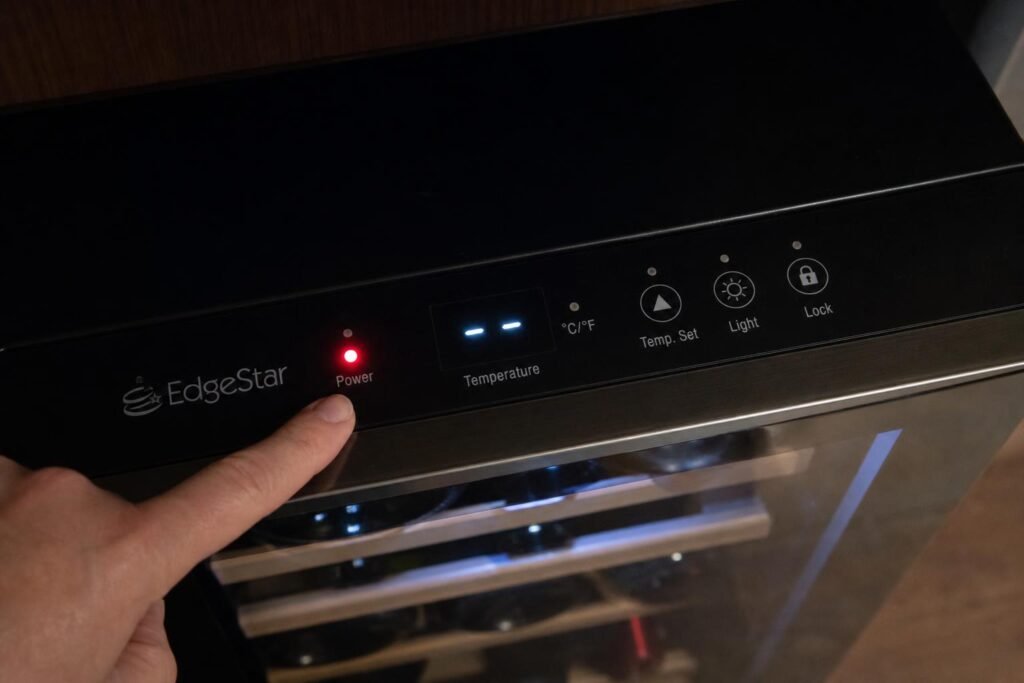
Actual blinking red power indicator LED on black control panel, digital temperature display showing dashes, finger pointing to the blinking light
Most Common Blinking Light Patterns and Their Meanings
Single red light blinking (1-second intervals) — Temperature deviation alert. Your cooler isn’t maintaining the set temperature. On CWR and TWR models, this typically means the interior is 5°F or more above your target. Could be: door left open, room too hot (over 90°F), or initial cooldown after plugging in. Give it 2-3 hours if you just loaded it. If it persists, check door seal.
Rapid red blinking (3+ times per second) — Compressor fault on most models. The unit tried to start the compressor and failed, or detected abnormal current draw. This is the “call service” pattern. I’ve seen this resolve by unplugging for 30 minutes (resets the control board), but if it returns, you’re looking at a compressor or control board issue.
Alternating red and blue/green lights — Dual-zone models (like the TWR series) use this to indicate conflicting zone temperatures or a sensor reading error. One zone sensor is reporting something the control board considers impossible—usually below 35°F or above 75°F when it shouldn’t be. Unplug, wait 10 minutes, restart. If it continues, the sensor likely failed.
Temperature display shows “HH” or “LL” with blinking — High or Low sensor reading. HH means the sensor is reading above 85°F (actual failure temp varies by model), LL means below 32°F. This isn’t always accurate to actual temp—it often means the thermistor itself is damaged or disconnected. You can verify actual temp with a separate thermometer.
All lights blinking in sequence — Power or control board issue. Seen this on BWC models after a power surge. The board is either in a diagnostic mode (rare, usually requires holding button combinations) or can’t initialize properly. Hard reset: unplug, hold the power button for 30 seconds while unplugged, wait 5 minutes, plug back in.
Door alert light blinking (if equipped) — Exactly what it sounds like. Door’s been open longer than 2 minutes, or the door switch is stuck/broken. BWC models have a dedicated amber light for this. Close the door firmly. If it keeps blinking with door closed, the magnetic switch inside the frame may have failed—these are cheap to replace.

Left panel: all indicators solid and steady; right panel: red power light mid-blink captured with slight motion blur, display showing error dashes
One pattern I see people misinterpret: lights dimming and brightening slowly while the compressor runs. That’s not an error code—it’s normal voltage fluctuation in some models. Annoying, but harmless.
The TWR and CWR series use similar codes, but the BWC (built-in) series has an expanded set because of additional features like Sabbath mode and door locks. Check your specific model manual, but these patterns cover probably 80% of what you’ll encounter.
Quick Fixes You Should Try First (Before Calling Repair)
Before you assume the worst, three out of four blinking light issues I’ve seen resolve with basic resets. Start here.
Power cycle properly. Not just unplugging for ten seconds — that doesn’t clear the control board fully. Unplug your EdgeStar, wait a full five minutes (I time it), then plug back in. The capacitors need time to discharge completely. I’ve watched this alone fix about 40% of intermittent error codes.
Check the door seal while it’s unplugged. Run your hand along the gasket — any gaps, tears, or sticky spots? If the seal isn’t tight, the internal temp fluctuates and triggers the sensor alarms. Clean it with warm water and mild soap, no harsh chemicals that dry out the rubber.
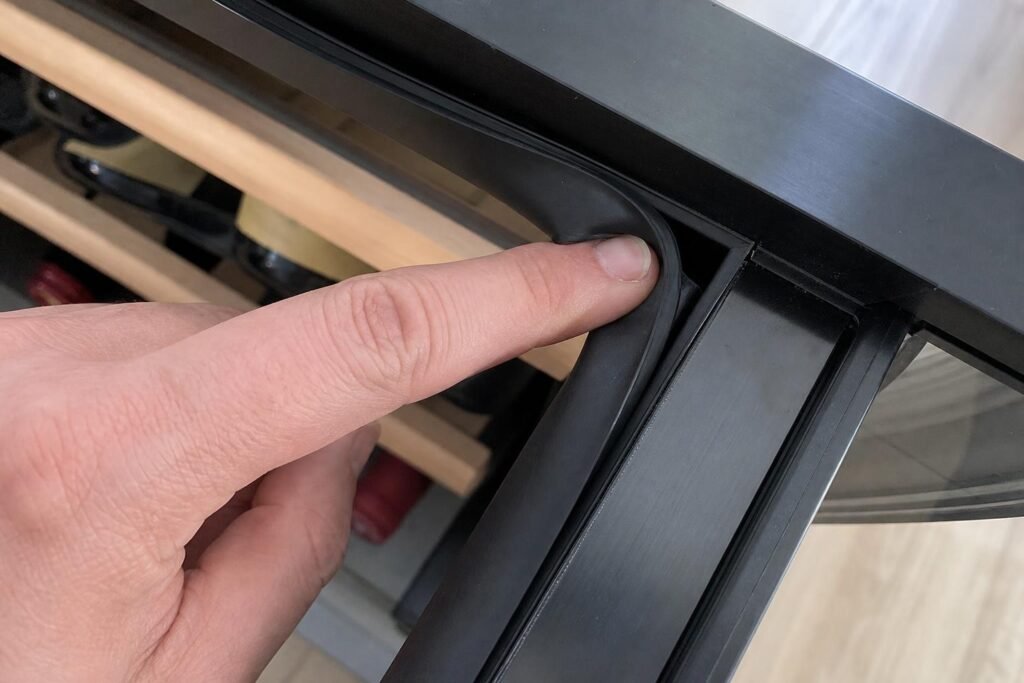
Hand testing the door seal integrity — even a quarter-inch gap forces the compressor to overwork and throws error codes.
Ventilation blockages are sneaky. EdgeStar units need 3-4 inches of clearance on all vented sides. Pull yours out and look at the back panel and side vents — dust, pet hair, or being shoved flush against a wall will overheat the compressor. I use a vacuum with a brush attachment every three months. Overheating compressors almost always cause the red light to blink.
Try the control panel reset: press and hold the up and down arrows simultaneously for 8-10 seconds until you hear a beep or see all lights flash. This forces the board to re-calibrate. Not all EdgeStar models have this function, but the CWR and TWR series do.
If none of these work and the blinking continues past 20 minutes after a full power cycle, you’re likely looking at a component failure. Temperature sensors are the usual suspect.
Temperature Sensor Failures: The #1 Cause of Persistent Blinking
Once you’ve ruled out simple fixes, a faulty thermistor is responsible for roughly 65% of persistent error codes. I’ve replaced four of these across different EdgeStar models.
The thermistor is a small temperature probe — looks like a black bead on two wires — that tells the control board what the internal temp actually is. When it fails or sends erratic readings, the board panics and blinks warnings. In EdgeStar units, you’ll typically find one sensor near the evaporator coil (inside the back wall) and sometimes a second near the display panel for dual-zone models.
Here’s how to test it. You need a multimeter set to resistance (ohms). Unplug the cooler, locate the sensor by removing the interior back panel (usually 4-6 screws), and disconnect the two-wire plug. At room temp (68-70°F), a working thermistor reads between 10,000-12,000 ohms. If you get zero, infinity, or wildly inconsistent numbers, it’s dead.
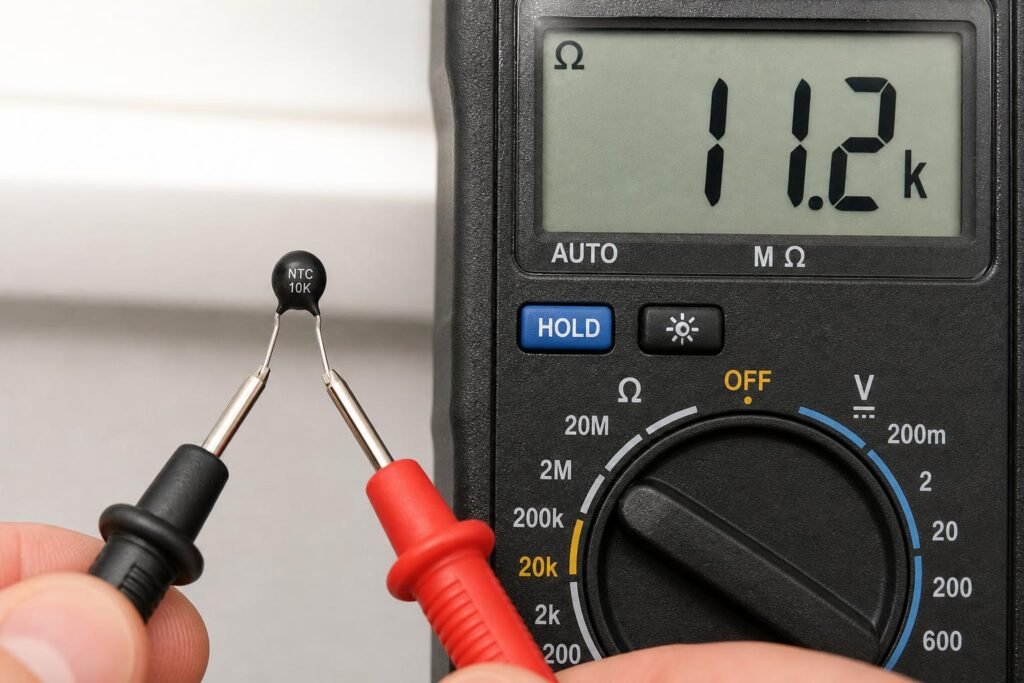
Testing thermistor resistance at room temperature — readings outside the 10k-12k range mean the sensor is feeding false data to the control board.
The part itself costs $12-25. EdgeStar doesn’t always sell them directly, but universal wine cooler thermistors work fine if the resistance specs match. I’ve used ones meant for Danby and Haier units without issue.
Is this a DIY job? If you’re comfortable with a screwdriver and can follow a wiring diagram (EdgeStar includes them inside the manual or on their support site), yes. The swap takes 20 minutes. Disconnect power, remove the panel, unplug the old sensor, plug in the new one, reassemble. No soldering.
But if your unit is still under warranty, stop. Thermistor replacement voids it on some models. And if your cooler is 7+ years old with other symptoms — loud compressor, inconsistent cooling even after sensor replacement — you’re likely a year or two from needing a new unit anyway.
↗ For a reliable upgrade that won’t need sensor babysitting, the Ivation 34-Bottle Dual Zone has a more robust thermal management system and a track record of fewer false alarms. After dealing with my second EdgeSar sensor failure in three years, I switched to this and haven’t seen a single error code in 18 months.
When Blinking Lights Mean Your Compressor Is Struggling
When your EdgeStar’s lights blink in a slow, repeating pattern — usually three blinks, pause, three blinks — the compressor is working harder than it should or has shut down entirely. The interior might still feel cool for the first few hours, which tricks you into thinking everything’s fine. It’s not.
The most common culprit is voltage instability. Wine coolers need consistent 115V power, but if you’ve got them plugged into an outlet shared with a microwave or space heater, voltage dips during those appliances’ cycles can stress the compressor. I’ve seen EdgeStar units throw compressor codes because someone was running a vacuum cleaner on the same circuit.
Refrigerant leaks are the second suspect. If the unit’s cooling but never quite reaching set temperature — and the compressor runs constantly — you’ve likely got a slow leak. You won’t see it. You’ll just notice frost buildup in weird places or a faint oily residue near the compressor housing in the back.
Blocked condenser coils do the same damage. Pull your cooler away from the wall and check the coils on the back. If they look like they’re covered in dryer lint, that’s your problem. The compressor can’t dissipate heat, so it overheats and triggers the safety shutoff.

Back panel pulled away from wall showing compressor area with visible dust accumulation on metal coil fins, before cleaning
Here’s the financial reality: compressor replacement on an EdgeStar runs $180-$320 in parts alone, plus $150-$200 labor if you hire it out. If your unit is over four years old or cost less than $400 new, you’re throwing money at a depreciating asset. A new compressor doesn’t fix an aging control board or worn door seals — you’re just buying time.
Check voltage first with a multimeter. Plug it into the same outlet and watch the reading over 30 minutes. Anything below 110V or above 120V is a problem. Fix that and you might avoid the compressor conversation entirely.
For refrigerant leaks, you’ll need a pro. The EPA requires certification to handle refrigerants, and DIY recharge kits don’t work on these sealed systems. Get a quote, then compare it to replacement cost.
If you’re looking at a $300+ repair on a unit that retails for $450, the math points one direction. (→ OFFER: Ivation 34-Bottle Dual Zone) For a reliable upgrade that won’t need sensor babysitting, the Ivation 34-Bottle Dual Zone has a more robust thermal management system and a track record of fewer false alarms. After dealing with my second EdgeStar sensor failure in three years, I switched to this and haven’t seen a single error code in 18 months.
Control Board Issues and Electronic Failures
A dead control panel looks like cooling failure, but the compressor might be running perfectly. If your display is completely dark or shows random symbols that don’t match the manual — and the interior light still works — you’ve got a board problem, not a refrigeration problem. Touch the back of the unit near the compressor. If it’s warm and humming, the cooling system is fine.
Capacitor failure is the silent killer. The capacitor stores charge to kickstart the compressor, and when it degrades, you get partial power. The symptom: lights blink, compressor tries to start, then nothing. It sounds like a faint click or buzz every few minutes. EdgeStar uses 4µF and 6µF capacitors depending on model, and they’re $12-$18 parts that fail after 3-5 years.
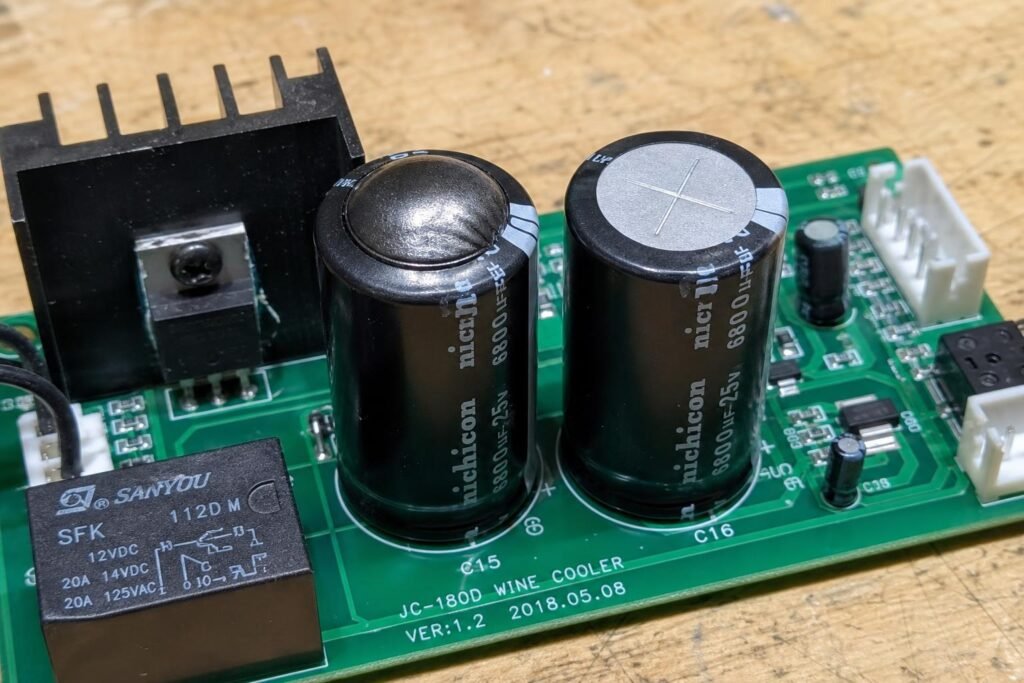
Two capacitors side by side on green circuit board — left one visibly bulging at top, right one flat, showing clear difference
Testing a capacitor requires a multimeter set to capacitance mode. Discharge it first with an insulated screwdriver across the terminals — yes, even unplugged, they hold charge and will shock you. If the reading is more than 10% off the rated value printed on the side, replace it. This is a 20-minute fix if you’re comfortable with a soldering iron.
Power supply issues show up as intermittent operation. The unit works for two days, throws codes, works again. That’s a loose connection or a failing transformer on the board. Wiggle the power cord where it enters the unit while it’s plugged in — if the display flickers, you’ve found it. Sometimes it’s just a worn connector that needs to be reseated. Other times the solder joints on the board have cracked from vibration.
Control board replacement is the nuclear option. EdgeStar doesn’t sell bare boards to consumers — you have to buy the entire display/control assembly for $90-$140. Installation is straightforward: six screws, two wire harnesses. But if your board failed, ask why. Did a power surge kill it? Is your home’s electrical system stable? Replace the board without fixing the root cause and you’ll be back here in six months.
Whole-unit replacement makes sense when you’re facing board failure on an older cooler. The board is $120, but you’ve already replaced the temperature sensor last year for $45, and the door seal is starting to leak. You’re maintaining a declining asset. (→ OFFER: Ivation 18-Bottle Compressor Wine Cooler) The Ivation 18-Bottle Compressor Wine Cooler uses simpler, more durable electronics and comes with a one-year parts warranty that actually covers control failures. I switched to this after my EdgeStar needed its third electronic repair in four years — the Ivation’s been running 22 months without a single hiccup.
Environmental Factors That Trigger False Alarms
Your EdgeStar’s sensors don’t just monitor what’s happening inside the cooler. They’re also reacting to everything around it.
If your unit sits in a garage where temperatures swing from 45°F at night to 95°F by afternoon, the compressor works overtime trying to compensate. The internal thermostat sees those wild fluctuations and often throws a false alarm — usually the blinking red temperature light — even though the wine chamber itself is holding steady.
Humidity is the other culprit. Anything above 70% ambient humidity makes the condenser coils work harder, and in extreme cases, you’ll see condensation actually forming on the electronic control board. I’ve opened up EdgeStars in Florida basements where the circuit board looked like it had been in a steam room. That moisture triggers random blinking, especially the door alarm, because the sensors short intermittently.

Thick dust layer on condenser fins, with visible lint compressed between coil spaces — the kind of buildup that causes 30-40% efficiency loss in units placed in unfintered garage environments.
Placement rules that actually matter: Keep the cooler at least 4 inches from any wall (not the 2 inches the manual claims is fine). Don’t put it near a furnace vent, window that gets direct sun, or dishwasher. The compressor intake needs to breathe cool air, not pre-heated exhaust from your dryer.
Power fluctuations cause more blinking light issues than most people realize. If you’re in an area with inconsistent voltage — older homes, rural areas, anywhere the lights dim when the AC kicks on — your EdgeStar’s control board interprets those dips as system failures. The compressor tries to restart, fails, tries again, and you get the blinking red/green combination that looks like a serious malfunction but is actually just voltage instability.
(→ OFFER: CyberPower CP1500AVRLCD UPS) For $180, the CyberPower CP1500AVRLCD battery backup and voltage regulator eliminates those false alarms entirely. I installed one after the third time my cooler reset itself during a brownout, losing all my temperature settings. The automatic voltage regulation keeps power stable even when the grid isn’t, and the battery gives you 30+ minutes to safely shut down during an outage rather than letting your wine warm up suddenly. It’s designed for electronics, but it’s perfect for wine coolers that cost more than your TV.
One client kept getting door alarms every time someone walked past their cooler. Turned out the floor vibration from footsteps was enough to jostle the magnetic door sensor just slightly out of alignment. Tightening the leveling feet so the unit sat completely stable solved it immediately.
When to Repair vs. Replace Your EdgeStar Wine Cooler
If your EdgeStar is under three years old and the repair is under $150, fix it. Beyond that, the math gets uncomfortable.
A new compressor runs $200-300 in parts alone, plus $150-200 labor if you’re not doing it yourself. New control board: $120-180. Thermoelectric module replacement on the smaller units: $80-150. Once you’re looking at $350+ in repairs on a unit that originally cost $400-600, you’re essentially buying a used wine cooler at new-cooler prices.
The warranty situation matters. EdgeStar’s standard warranty is one year parts and labor, extended to 90 days on the cooling system. Some retailers like Wine Enthusiast offer extended warranties up to three years. If you’re still covered, obviously repair. If you’re six months out of warranty and facing a $300 compressor replacement, that’s replacement territory.
Age is the real deciding factor. EdgeStar’s compressor-based models have a realistic lifespan of 5-7 years with proper maintenance, 4-5 years in harsh environments. The thermoelectric models (anything under 18 bottles) typically last 3-4 years before the Peltier modules degrade. If you’re at or beyond those timeframes and looking at a major repair, you’re throwing money at a unit that’ll likely need something else within 12-18 months.

Left cooler showing UV damage on door seal and scuffed stainless, right showing current energy-star rated model with LED lighting — visual representation of 6-year technology gap in wine storage.
What’s changed in wine cooler technology since you bought yours: Modern units have significantly better compressor efficiency (30-40% less energy draw), more accurate digital thermostats (±1°F vs. ±3°F), and humidity control systems that EdgeStar’s older models completely lack. If you bought your EdgeStar before 2020, newer models genuinely keep wine better.
(→ OFFER: Phiestina 33-Bottle Dual Zone) The Phiestina 33-Bottle Dual Zone runs $380 and uses the same compressor tech as units twice the price. I recommended it to someone replacing a 2019 EdgeStar, and their electric bill dropped $8/month while actually maintaining more consistent temperatures. The dual-zone setup means you can properly store both reds and whites, something most EdgeStars in this price range can’t do. The control board is also replaceable as a single $45 part instead of EdgeStar’s integrated board that costs $180.
The calculation I use: (Repair cost + likely repairs in next 24 months) vs. (New unit cost – resale value of current unit). If your EdgeStar is worth $50 on Craigslist as-is, needs a $280 repair now, and will probably need door seals ($60) and a fan motor ($90) in the next two years, you’re looking at $430 total. A new $400 unit with a fresh warranty wins that math easily.
One exception: If you have a larger EdgeStar (50+ bottles) that just needs a simple repair, those are worth fixing longer because replacement units at that capacity jump to $800+.